



The gaming industry stands at the threshold of its most transformative era yet. With 2.6 billion players worldwide participating in a $160 billion market, artificial intelligence is no longer a futuristic concept but an active force reshaping how games are created, experienced, and played. From intelligent characters that adapt to your decisions to entire worlds generated on the fly, AI is fundamentally changing what gaming can be.
What makes this transformation particularly fascinating is that we’re only scratching the surface. While today’s games still rely heavily on traditional programming methods, the integration of advanced AI technologies promises to unlock dimensions of interactivity, realism, and personalization that were previously impossible to achieve.
Understanding AI’s Current Role in Gaming
Before exploring where AI will take gaming, it’s essential to understand where we stand today. Despite the visual complexity of modern titles like Grand Theft Auto or Minecraft, most games still operate on relatively simple “if-then” logic rather than true learning intelligence.
The Limitations of Traditional Game AI
Current video game AI isn’t truly intelligent in the way we might imagine. Games are designed with predictable outcomes in mind, even when they appear layered and complex. The algorithms driving enemy behavior, difficulty scaling, and environmental responses follow predetermined pathways rather than genuinely learning or adapting.
This limitation exists by design. Game developers maintain control over player experiences to ensure games remain beatable and enjoyable. Introducing unpredictability through advanced AI carries significant risks, including cost concerns and the potential loss of carefully crafted gameplay balance.
Where AI Makes an Impact Today
Despite these constraints, AI already enhances gaming in meaningful ways:
- Graphics Enhancement: Convolutional networks create photorealistic textures, lighting, and environmental details by analyzing real-world imagery
- Performance Optimization: AI compresses game data and dynamically allocates resources for smoother gameplay and faster loading times
- Basic Opponent Behavior: Simple machine learning helps enemies respond more naturally to player positions and actions
- Automated Testing: AI-powered playtesting identifies bugs and balance issues far faster than human testers alone
How AI is Revolutionizing Game Development
The most immediate impact of AI in gaming happens behind the scenes, transforming how developers create the experiences we enjoy.
Automated World Building and Asset Generation
Creating expansive game worlds manually demands enormous time and financial investment. A single detailed 3D environment can require hundreds of hours from skilled artists and designers. AI fundamentally changes this equation.
Advanced algorithms can now analyze architectural data and terrain information to generate realistic buildings, landscapes, and entire ecosystems. These systems consider gameplay factors like sight lines, cover opportunities, and navigation paths while producing visually authentic environments.
The benefits extend beyond major landmarks. AI can generate infinite variations of smaller assets like furniture, vegetation, and props to populate game worlds with density that would be impossible to achieve manually. This liberation from tedious asset creation allows developers to focus their creative energy on higher-level design and storytelling.
Intelligent Data Optimization
Modern games contain massive amounts of data including 3D models, high-resolution textures, audio files, and complex environment geometry. AI algorithms analyze this data to compress files without sacrificing visual quality or player experience.
Beyond static optimization, AI performs real-time performance analysis during gameplay. It dynamically adjusts resource allocation, directing computing power where it’s needed most at any given moment. This intelligent load balancing ensures games run smoothly across various hardware configurations.
Accelerated Testing and Quality Assurance
Exhaustive playtesting is crucial for identifying mechanical issues, balance problems, and bugs before release. Traditionally, this process requires massive human effort over weeks or months. AI simulation tools powered by machine learning can play through complex games in days while accurately modeling human behavior patterns.
The data generated by AI testing provides more comprehensive insights than human feedback alone. Developers receive concrete metrics and visualizations about what functions properly versus what needs refinement, enabling precision tuning that elevates final game quality.
| Development Area | Traditional Method | AI-Enhanced Method | Time Savings |
|---|---|---|---|
| Asset Creation | Manual modeling and texturing | Algorithmic generation with human oversight | 60-80% |
| Playtesting | Human testers over weeks | AI simulation in days | 70-90% |
| Data Optimization | Manual file compression | Automated AI analysis | 50-70% |
| Environment Design | Individual scene construction | Procedural generation with parameters | 40-60% |
Transforming Player Experiences Through AI
While development improvements are significant, the true revolution lies in how AI will fundamentally change what players experience when they launch a game.
The Evolution of Non-Player Characters
NPCs in today’s games often feel robotic and repetitive, following simple behavioral scripts. The next generation of AI-powered characters will be dramatically different.
Advanced natural language processing will enable NPCs to understand and respond to player dialogue in contextually appropriate ways. Characters will remember previous interactions, reference shared experiences, and adjust their reactions based on the relationship they’ve built with the player.
Emotional AI adds another layer of depth. NPCs will display nuanced emotional responses that feel authentic to their personality and circumstances. Their behavior will vary substantively while remaining true to their backstory, creating the sensation of interacting with multidimensional characters rather than quest dispensers.
Dynamic learning algorithms will make NPC behavior genuinely unpredictable within appropriate boundaries. Enemies will analyze player patterns and adapt their strategies. Allies will complement your playstyle in increasingly sophisticated ways. Every encounter will feel fresh rather than scripted.
Procedural Content Generation at Scale
Games like No Man’s Sky have demonstrated the power of procedural generation, but we’re only beginning to explore this technology’s potential. Future AI systems will create not just terrain and planets, but entire quest lines, narrative branches, and game mechanics that have never existed before.
These aren’t random arrangements of predefined elements. Advanced AI can understand narrative coherence, pacing, and player engagement to generate content that feels intentionally designed. Each playthrough becomes a unique journey through a world that literally didn’t exist until you started playing.
Personalization Through Player Behavior Analysis
Imagine a game that learns your preferences over dozens of hours and tailors every aspect of the experience to your individual tastes. This level of personalization is becoming reality through AI.
Machine learning algorithms can observe how you play, what choices you make, which challenges you enjoy, and which frustrate you. The game might introduce companions whose personalities complement or productively clash with yours. Environments could emphasize exploration versus combat based on detected preferences. Difficulty could adjust not just to your skill level but to your desired challenge intensity at any given moment.
This creates games where every player’s journey feels specifically crafted for them, dramatically increasing emotional investment and enjoyment.
Dynamic Difficulty and Intelligent Pacing
Most games struggle to balance difficulty across varied player skill levels. Set the challenge too high, and casual players quit in frustration. Make it too easy, and experienced players become bored.
AI “directors” solve this problem by monitoring performance in real-time. The system seamlessly adjusts enemy intelligence, resource availability, and environmental hazards to provide perfectly balanced challenge levels for individual ability and growth. Players remain in the sweet spot where games feel engaging without becoming overwhelming or trivial.
Beyond difficulty, AI can modulate narrative pacing, puzzle complexity, and combat frequency to match engagement preferences. If the system detects waning interest, it might accelerate the story or introduce a new gameplay element. If you’re deeply engaged, it allows more time for exploration and experimentation.
Related: A Beginner’s Guide to Online Multiplayer Games
The Technology Driving Gaming’s AI Future
Generative Adversarial Networks in Game Creation
Generative Adversarial Networks represent one of the most exciting developments for gaming’s future. These systems pit two neural networks against each other to produce entirely new content.
GANs can implement style transfer, using photographs or video feeds to replace in-game assets with hyper-realistic alternatives. They can generate game mechanics and rules that have never been conceived before, potentially creating self-evolving games that remain fresh indefinitely.
Developers describe working with GANs as watching a computer dream. With minimal direction, these systems produce fascinating results that augment human creativity in unprecedented ways. It’s collaborative creation between human vision and machine capability.
Real-Time Ray Tracing and Visual Fidelity
AI combined with technologies like real-time ray tracing is pushing visual realism to extraordinary levels. These systems analyze how light behaves in the real world to create photorealistic shadows, reflections, and environmental lighting.
Nvidia’s DLSS technology uses AI to upscale lower-resolution images in real-time, delivering high-quality graphics at playable frame rates. This allows players to experience visually stunning games without requiring prohibitively expensive hardware.
Physics Simulation and Animation
Current game animations have a subtly synthetic quality despite motion capture technology. AI trained on vast libraries of real-world movement can generate hyper-realistic animations that capture the fluidity and dynamism of actual human motion.
Physics simulation benefits similarly. Objects will splinter, wind will billow, and particles will scatter exactly as they would naturally. This physics fidelity strengthens immersion by eliminating the subtle cues that remind us we’re in a virtual environment.
Beyond Entertainment: AI Gaming’s Broader Impact
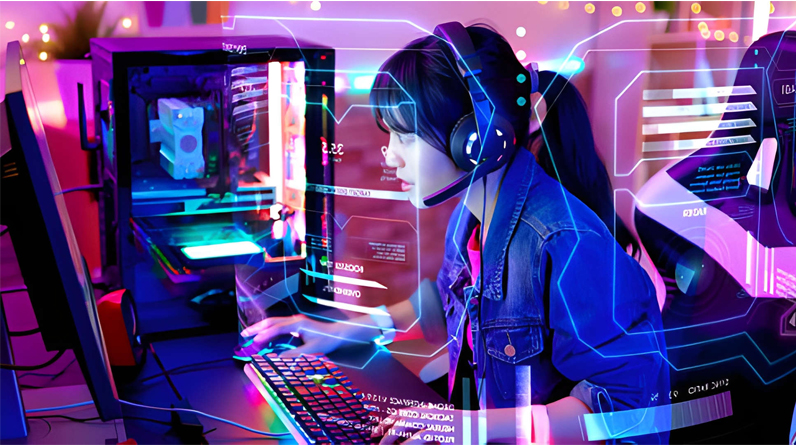
Job Creation and Economic Opportunity
The convergence of AI and gaming is creating employment opportunities on an unprecedented scale. If billions of people are playing games at any moment, millions will ultimately work in gaming-related fields.
These jobs span diverse areas:
- AI algorithm development and optimization
- Procedural content design and curation
- NPC behavior scripting and emotional modeling
- Data analysis and player experience optimization
- Quality assurance and AI testing supervision
- Narrative design for adaptive storytelling systems
For many young people, gaming may represent their earliest viable income opportunity, whether through development, content creation, competitive play, or community building.
Training AI for Real-World Applications
An often-overlooked aspect of gaming AI is how the relationship works in reverse. Researchers use video games as training grounds for AI that will eventually solve real-world problems.
Organizations like DeepMind and OpenAI employ reinforcement learning in gaming environments, teaching AI to problem-solve through extreme trial and error. These systems start with simple games like Pong and progress to complex titles like StarCraft II and Dota 2.
The goal extends beyond creating better games. Success in virtual spaces translates to highly capable AI for manufacturing, autonomous vehicles, logistics optimization, and countless other applications. Games provide controlled, measurable, diverse environments perfect for testing and refining AI capabilities before real-world deployment.
Challenges and Considerations
The Cost Barrier
Implementing advanced AI in games remains expensive. Developing sophisticated machine learning systems, training them with adequate data, and integrating them seamlessly into game engines requires significant investment that many studios cannot afford.
This economic reality means AI adoption will likely remain uneven across the industry, with major publishers leading innovation while smaller independent developers rely on more traditional methods or accessible AI tools.
Control Versus Unpredictability
Games are experiences carefully designed to evoke specific emotions and provide particular challenges. Introducing truly adaptive AI creates tension with this design philosophy.
If NPCs become too unpredictable, they might break narrative flow or create frustrating gameplay situations. If procedurally generated content lacks quality control, players might encounter broken quests or incoherent storylines. Balancing AI capability with intentional design remains an ongoing challenge.
Ethical and Privacy Concerns
Personalized gaming experiences require collecting and analyzing substantial player data. This raises important questions about privacy, data security, and how information is gathered, centralized, and used.
As AI becomes more integrated into gaming, the industry must address these concerns transparently and implement robust protections for player information. The same technologies that create engaging experiences could be misused if proper safeguards aren’t established.
What the Future Holds
The trajectory of AI in gaming points toward experiences that would seem like science fiction today. Within the next decade, we can reasonably expect:
- Fully Reactive Game Worlds: Environments that reshape themselves based on player decisions to an almost limitless degree, creating truly nonlinear narratives
- Indistinguishable NPC Interactions: Characters with such sophisticated emotional depth and conversational ability that distinguishing them from human players becomes challenging
- Self-Evolving Games: Titles that use AI to continuously generate new content, mechanics, and challenges, remaining fresh indefinitely
- Seamless Cross-Medium Experiences: Games that blend with educational content, cinematic storytelling, and even therapeutic applications through adaptive AI
- True Photorealism: Visual fidelity indistinguishable from reality across vast game worlds without texture repetition or asset limitations
These advancements won’t eliminate human creativity from game development. Rather, AI will serve as a collaborative partner, handling technical complexity and repetitive tasks while freeing developers to focus on vision, artistry, and emotional resonance.
Conclusion: A Paradigm Shift in Interactive Entertainment
The role of AI in gaming’s future extends far beyond making games prettier or enemies smarter. We’re witnessing a fundamental transformation in how interactive entertainment is conceived, created, and experienced.
From development studios where AI accelerates creation and reduces costs, to living rooms where players engage with worlds that adapt uniquely to them, artificial intelligence is becoming inseparable from the gaming experience. The technology that once powered simple pathfinding algorithms for Pac-Man ghosts now generates entire universes, crafts emotionally complex characters, and personalizes adventures in ways that feel almost magical.
The challenges are real including cost barriers, control concerns, and ethical questions that demand careful consideration. Yet the potential benefits dramatic improvements in accessibility, unprecedented creative possibilities, and economic opportunities for millions make this transformation inevitable.
As we look ahead, one thing becomes clear: the future of gaming isn’t just enhanced by AI. In many fundamental ways, AI is becoming the future of gaming itself. For the 2.6 billion players worldwide and the millions who will work in this expanding industry, that future promises to be more immersive, more personalized, and more extraordinary than anything we’ve experienced before.
The game is changing. And we’re all players in this revolution.